TL;DR
If you create content or run a brand outside the US, Canada or India, check Google's Search profile claim page now. Reported sightings show it opening in new markets, and a claimed profile lets you shape the bio, links and posts Google shows for you.
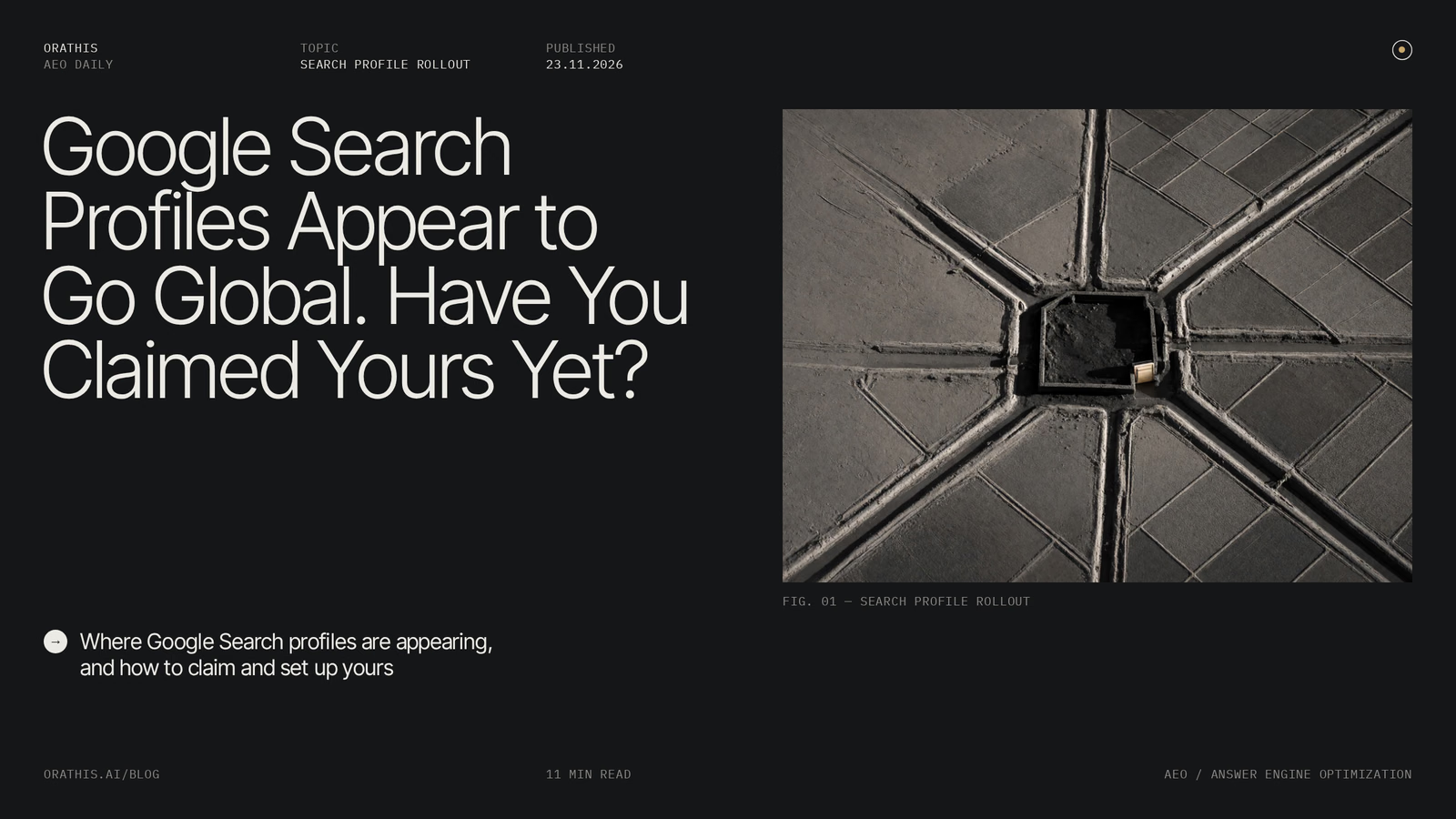
Google's Search profile sign-up has started appearing for SEO practitioners in Spain, Australia, Singapore and Dubai. That could let creators, publishers and brands far beyond the US, Canada and India shape how Google presents them in Search. Google is also testing links to these profiles from video results in AI Mode, Google's chat-style AI search.
A Search Engine Roundtable report on Sunday, November 22, 2026, said Google appears to have rolled Search profiles out globally. The report said people outside the three listed countries can now claim a profile without a VPN, a tool that makes your connection look like it comes from another country. The report rests on two posts on X. SEO consultant Clara Soteras wrote that Search profiles "showed up in Spain." Gagan Ghotra replied that the option was "showing up" on Gmail accounts with Australia, Singapore and Dubai addresses.
Key takeaways
- Google Search profiles collect a creator's, publisher's or brand's posts, videos and links on one Google-hosted page, and on November 22, 2026, two SEO practitioners reported on X that the sign-up option appeared in Spain and on accounts tied to Australia, Singapore and Dubai.
- A claimed profile lets its owner pin up to 8 posts, add up to 8 links and suggest name and bio edits that may appear in their Knowledge Panel, the information box Google shows beside results when you search for a known person or brand.
- For individuals and publishers, Google says the Knowledge Panel features an AI-generated summary based on the Search profile bio, so the bio wording directly feeds that summary.
- Google is testing clickable creator and publisher names on AI Mode video results that link directly to their Search profiles.
- Google has not announced the expansion, and its help pages still list only the United States, Canada and India.
Where Google Search Profiles Are Showing Up Now
Spain has the most detailed report so far, and the Australia, Singapore and Dubai sightings followed the same day. Soteras wrote: "Search Profiles seem to be rolling out to new regions! Today they showed up in Spain. Until now they were only available in the USA and Canada." Search Engine Roundtable says Soteras was able to claim a profile there.
PPC Land's write-up of the Spain sighting describes the image Soteras shared. It shows a screen headed "Verify your eligibility," with sign-in rows for YouTube, Instagram, X and TikTok. Each row lists a 10,000 subscriber or follower minimum.
Ghotra's reply widened the story: "Seems like a global rollout may be, I just checked through my gmails with AU/Singapore/Dubai addresses." PPC Land also points to a separate November 20, 2026 report from Jetstream that profiles had opened in Japan in mid-November.
What Are Google Search Profiles, and How Could They Change Who Gets Found in Google Search?
Search profiles are Google-hosted pages that gather a person's or brand's social accounts, videos, posts and links in one place. They could change who gets found by giving people with a social audience their own presence inside Google, separate from their website.
Google's help page on claiming a profile says profiles pull in content from YouTube, Instagram, TikTok and X. Google says this "makes it easier for users to find your content on Google Search or Google Discover." Discover is the article feed in the Google app.
The product has opened up quickly. Google launched it in the US in June 2026. At launch, PPC Land reports, the bar was 100,000 followers on YouTube, Instagram or X, or 300,000 on TikTok. On September 16, 2026, Google product manager Ibrahim Badr cut that to 10,000. Search Engine Journal's report on the threshold cut quotes him: "We've lowered the eligibility threshold to 10,000 followers across YouTube, Instagram, X, or TikTok."
On October 6, 2026, Robby Stein, Google's VP of Product for Search, announced India and Canada on X. A second Search Engine Journal report quotes him: "One of our most requested updates for Search profiles is live today: expanding to new countries!" He described Brazil as "rolling out soon." Google's creators site still says profiles are "currently available in the US, Canada and India with plans to expand to other countries later in the year."
Profiles are also reaching AI search. In a Google blog post on AI Mode and AI Overviews updates, Google wrote: "This week, we started testing clickable creator and publisher names on video results that link directly to their Search profiles in AI Mode." PPC Land dates that test to October 15, 2026.
How Do You Claim a Search Profile Outside the US, Canada and India?
You claim it at profile.google.com/claim, the same page Google documents for its listed markets. Google has not published claim steps or eligibility rules for Spain, Australia, Singapore, the UAE or any other newly reported market. The rules and steps below are the ones Google documents for the US, Canada and India.
Google's documented requirements for its listed markets:
- You must be at least 18 years old.
- You need at least 10,000 followers on a single supported platform: Instagram, TikTok, YouTube or X. Follower counts from different platforms are not added together.
- If a YouTube channel is linked to the profile, you must sign in with that channel's Google Account.
- Check for an auto-generated profile first. Search your name. Next to your Knowledge Panel, click More, then View Search Profile. If you have no Knowledge Panel, Google has not generated a profile for you.
To claim an existing profile:
- Go to profile.google.com/claim.
- Sign into the Google Account you want to use for the profile.
- Sign into a content platform account linked to the profile.
- Click Next.
- Confirm that the profile Google found is yours.
You may need to sign into up to 3 platform accounts. Google may also ask for a "Selfie with ID" to verify who you are.
To create a new profile: PPC Land summarizes Google's "Create a new Search profile" page as four steps. Go to the claim link, sign into your Google Account, sign into one platform account that meets the minimum, and click Create Profile.
Ownership rules: Only one Google Account can claim a given profile. One account can manage up to 10 profiles. Google offers no admin or multi-user roles, and transfers go through a support form.
How Do You Optimize Your Search Profile for Google's AI Search?
Treat the bio, links and pinned posts as the facts you want Google to repeat about you. The tactics below are Orathis's recommendations, tied to what Google documents about how the profile appears.
- Write the bio as your entity description. For individuals and publishers, Google's creators site says the Knowledge Panel will "feature an AI-generated summary based on your bio." Use the same name, role and focus that appear on your website and LinkedIn. Name and bio changes go through Google review, so draft carefully before you submit.
- Use the 8 web links to confirm identity. Point to your homepage, your about or author page, and your main content hubs.
- Link only relevant social accounts. Google says requests to add social accounts or content platforms that are irrelevant to the profile "might be denied," even if you can sign into them.
- Pin current, representative work, especially video. Google's AI Mode test links names on video results to the profile, so a viewer who clicks through should land on your strongest work.
- Keep brands separate. Google asks you to claim each brand, podcast or identity as its own profile.
- For brands, keep Google Business Profile accurate too. The creators site says a business's Knowledge Panel "will remain unchanged and connected to your Google Business Profile or brand profile."
At Orathis, we recommend that banks, credit unions, wealth managers and fintechs send every Search profile bio through the same compliance review as other public marketing copy. That covers the firm's own profile and especially those of individual advisors and executives, whose bios Google turns into an AI summary in their Knowledge Panel.
What Google Has Not Confirmed About the Rollout
Google has not announced Search profiles in Spain, Australia, Singapore, the UAE or Japan. Its help page lists only Canada, India and the United States. PPC Land found that the Spanish-language version of the creators site still says profiles are available only in the US. Brazil, which Stein described as coming soon on October 6, is still missing from the help page.
The evidence is two posts on X reported by two trade outlets, plus a Japan report relayed by PPC Land. Soteras's own words say only that profiles "showed up." PPC Land points out that the shared image shows an eligibility step, not a completed profile, and carries no web address, date or location. Google's pages also do not say whether thresholds or features differ by country.
Reaction so far comes mainly from the people who spotted the change. Soteras called it "big news for creators, journalists and brands," adding: "Search is no longer just about websites. It's about people, voices and communities." PPC Land raises a regulatory question: if the Spain report holds, Spain would be the first European Union country on record, and Google has not said how profiles work there.
What this means for AEO
In our view, the biggest shift is that a Search profile is Google's own written record of who you are, and the reported expansion brings that record to many more markets.
Google may already have generated a profile for anyone with a Knowledge Panel, whether or not they claim it. Left unclaimed, that profile shows whatever Google assembled. Claimed, it becomes one of the few places where Google takes text you wrote and uses it directly in an AI-written description of you.
The AI Mode test adds a new path from AI answers. When AI Mode shows a creator's video, the name can link to a page Google hosts, not to the creator's site. Your profile links decide whether that click ever reaches your own pages.
The people most likely to gain are individuals inside firms: advisors, analysts and founders with 10,000 followers on one platform. PPC Land notes the flip side. Experts who publish without a social following stay outside, whatever the quality of their work.
Measurement improves too. PPC Land reports that the profile's Insights beta shows clicks, impressions and audience reach by country, powered by Search Console. Google limits that beta to accounts above an unpublished follower count. For newly reported markets, the country breakdown can show whether local audiences are finding you.
Orathis's approach is to treat a Search profile like any other source we track for AI visibility: record what Google shows for the name before the claim, make the change, then compare.
What to do now
- Check whether Google already generated a profile for you, then claim or create one using the steps in "How Do You Claim a Search Profile Outside the US, Canada and India?" above.
- Choose a company-controlled Google Account as the owner before you start, because Google allows no admin roles and transfers require a support request.
- Save screenshots of your Knowledge Panel and AI Mode results for your name today. If an AI answer already describes you wrongly, trace the sources behind it before writing the bio.
- Draft the bio, up to 8 links and up to 8 pinned posts, and get them through any required compliance review.
If you want help checking how AI answers describe your firm and its people, talk to Orathis.
FAQ
Do you need a Knowledge Panel to get a Google Search profile?
You do not need a Knowledge Panel. Without one, Google does not generate a profile for you automatically, but you can create one from scratch if you have 10,000 followers on one supported platform. Google's creators site says claiming a profile may also give you a Knowledge Panel if you do not have one.
Is a Google Search profile the same as a Google Business Profile?
A Search profile is a separate product from Google Business Profile. Search profiles are built for creators, publishers and organizations that publish content. Google says a business's Knowledge Panel stays connected to its Business Profile or brand profile after a Search profile is set up.
Does a Google Search profile help you rank higher?
Google's documentation, as quoted by PPC Land and Search Engine Journal, says creating a Search profile "doesn't directly affect your content's ranking on Google Search." Its value lies in how you are presented and in the follow and click paths it creates.
Can one Google Account manage Search profiles for several brands?
One Google Account can claim and manage up to 10 Search profiles, according to Google's help page. Each profile can have only one owning account, so a second person needs that account's login to manage it.
About the author
Quinton Bean (Director at Orathis) wrote this article.
His published work explores answer engine optimization (AEO), generative engine optimization (GEO), and AI adoption. He has shared a GEO experiment comparing LinkedIn profile authority with on-site and off-site articles, and described his contribution to AskElephant's website and company rebrand.
Connect with Quinton Bean on LinkedIn.
Also in AI search on November 22, 2026
- ChatGPT Business Hub adds a button to connect an ad account. Search Engine Roundtable reported that the new ChatGPT Business Hub shows a "Connect an ad account" button at the top, with text saying it lets businesses promote themselves and reach more customers across ChatGPT.