TL;DR
Brands can now pay for a spot next to Bing's AI Overviews through existing Performance Max and AI Max campaigns, but an ad is not a citation. Check each key query for your citation and rivals' ads, then fund the gaps.
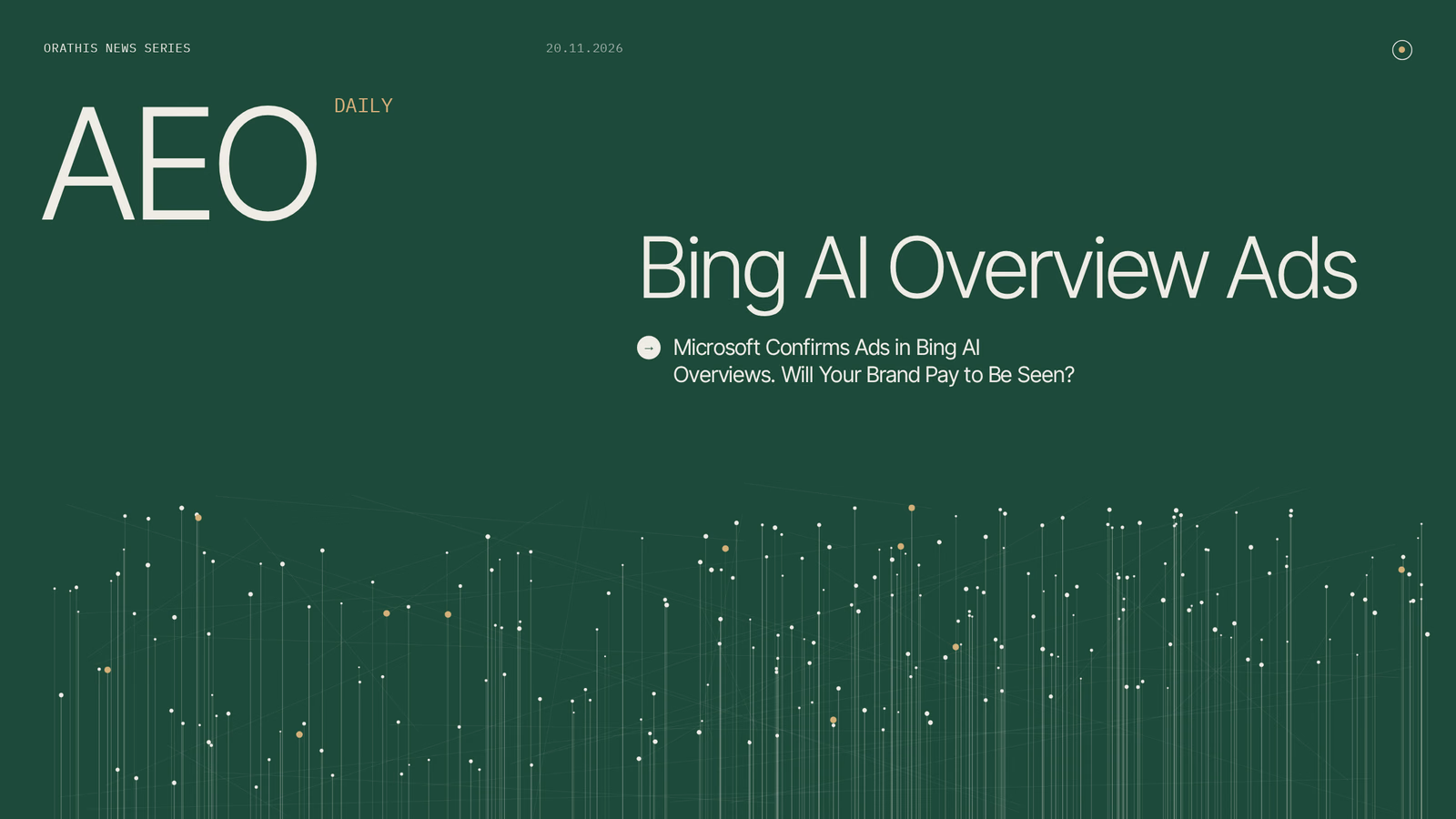
Microsoft is selling ad space next to Bing's AI Overviews, so a brand that never earns a citation can still put its offer beside one.
Microsoft confirmed the change on Thursday, November 19, 2026, in its November product roundup on the Microsoft Advertising blog. "Your ads can now show up next to AI-powered answers on Bing when your offers are relevant," the company wrote. The ads run through campaigns advertisers already use. Those include Performance Max, a campaign type where Microsoft's AI chooses where ads run, and AI Max, Microsoft's automated setting for Search campaigns. The placement is available in all markets except China. The confirmation came about three weeks after Search Engine Roundtable said it first started seeing ads in Bing AI Overviews.
Key takeaways
- Microsoft now shows ads next to AI Overviews in Bing Search, so a brand can appear beside an AI answer by paying, even when that answer does not cite it.
- Microsoft confirmed the placement on November 19, 2026. It runs through existing campaigns, including Performance Max and AI Max, in all markets except China.
- Brands that buy Microsoft ads and also track AI citations should now measure both on the same Bing queries, because one AI Overview can show a cited source and a paid offer side by side.
How Do Ads in Bing AI Overviews Change Which Brands Get Seen?
Ads give brands a paid way to appear beside Bing's AI answer, next to the brands that answer cites. Until ads appeared (first spotted around October 29, 2026), being cited was the only way to show up there.
Microsoft's own example is a traveler asking Bing about a trip to Snowdonia National Park. "The AI Overview might show a sample itinerary and travel tips," Microsoft wrote. "If you provide hotel accommodations, your ad can appear right next to that answer." Microsoft argues these answers "often reveal needs beyond the exact words someone typed."
So a hotel the itinerary never mentions can still sit beside it. Who appears next to an AI answer now depends on two things: who gets cited, and who pays.
Why Microsoft Is Selling This Space Now
Microsoft ties the move to a change in how people search. "Search is changing from a list of links to a faster path to an answer," the post says. It calls ads in AI Overviews "the latest step in bringing ads to AI experiences, building on ads in Copilot."
The timing also fits the holidays. The roundup opens with gift shoppers. It cites Microsoft's own July 2026 survey of 1,024 US consumers, in which 76% planned to use conversational AI to help with holiday shopping.
The ads showed up before the announcement. Khushal Bherwani shared a screenshot on X and wrote, "Bing is showing Sponsored Results within AI Overviews," according to Search Engine Roundtable's earlier report. Silverback Marketing's weekly roundup dates that screenshot to October 29, 2026. Search Engine Roundtable also noted that Bing had renamed its Copilot Search box to AI Overviews a few months earlier.
How Do Advertisers Get Their Ads Into Bing AI Overviews?
Advertisers get in through the campaigns they already run. Microsoft says, "There's no separate campaign set-up required."
Eligibility and availability. The placement is open in all markets except China. Microsoft names Performance Max and AI Max as eligible routes.
Steps 1 and 2 come from Microsoft's announcement. Steps 3 and 4 are AI Max rules from Microsoft's AI Max documentation and the November post. They are not documented requirements for AI Overviews, and the AI Max guide does not mention AI Overviews.
- Run a Performance Max campaign, or a Search campaign with AI Max turned on, in Microsoft Advertising.
- Target markets other than China.
- Meet the AI Max rules. AI Max is available only to eligible accounts and Search campaigns. Two of its features have extra prerequisites: search term matching, which shows ads on related searches without an exact keyword, and final URL expansion, which lets Microsoft pick the landing page. To turn either on, first add a Universal Event Tracking (UET) tag, a tracking script on your site, or set up an eligible offline conversion goal. Then create a conversion goal. Finally, use a conversion-based bid strategy, which sets bids around tracked sales or sign-ups, or a portfolio bid strategy, which shares one strategy across several campaigns.
- Optionally, add URL inclusions, which Microsoft says are rolling out now. They tell AI Max which pages to send traffic to and which pages to pull ad text from. Some accounts need extra eligibility for them.
What is not available. Microsoft's announcement describes no campaign type or bid just for AI Overviews. It describes no switch to opt in or out of the placement, and no separate AI Overviews report. Microsoft has not said whether standard Search campaigns without AI Max qualify.
How Should Brands Balance Paid Ads and Organic Citations in Bing AI Overviews?
Let each query decide. Put paid budget where a rival takes the space next to your answer, and put organic work where you can earn the citation.
At Orathis, we recommend checking three things for each priority commercial query on Bing:
- Does Bing show an AI Overview?
- Does the answer cite your domain?
- Does an ad appear next to the answer, and whose is it?
Microsoft's AI Performance dashboard in Bing Webmaster Tools helps with the second question. It shows total citations and grounding queries, the phrases AI used to retrieve the pages it cited. It also maps each grounding query to the pages it cites. The dashboard counts citations across all the AI answers Microsoft grounds, so check Bing results by hand to see the AI Overview and any ads.
Then match your action to what you find:
| What you see on the query | Our suggested move |
|---|---|
| You are cited, and a competitor's ad sits beside the answer | Consider bidding to protect that moment |
| You are not cited, and a competitor advertises | Fix the organic page first, then test paid |
| You are not cited, and no ad appears | Focus on organic content work |
| You are cited, and no ad appears | Monitor the query |
One more tactic is ours, not Microsoft's. If you use AI Max, point URL inclusions at the pages that already earn citations. Then the ad and the cited source tell the reader the same story.
What Microsoft Has Not Said
So far, public reaction has come from trade outlets and social media comments. Search Engine Watch described the ads as appearing "alongside AI-generated answers." Its writer said they had spotted sponsored results in Bing AI Overviews earlier. In October, Search Engine Roundtable's Barry Schwartz wrote that he could not trigger the ads himself.
PPC Land noted that Microsoft's post gives no launch date and does not say whether the ads were tested in some markets first. Microsoft calls Performance Max and AI Max "the most effective way to show up in AI experiences." PPC Land says that line is Microsoft's own judgment, not a measured result.
Under Schwartz's LinkedIn post, one commenter wrote that the ads "turn AI answer visibility into a paid-and-organic layout question, not just a citation question." Another said they would need to check "how often a business still gets named when an ad takes the top spot."
Microsoft has not said:
- how it picks ads, beyond "when your offers are relevant"
- whether ads change which pages the AI Overview cites
- exactly where the ad sits. Microsoft says "next to," while Bherwani's October post said "within."
- how the ads are labeled, or whether pricing and bidding differ from other placements
- any performance data for this placement
What this means for AEO
In our view, Bing's AI Overview is no longer a purely organic space. Before ads arrived this fall, the brands beside a Bing AI answer were the brands it cited. Now a competitor with no citation can buy that space on the same query.
That changes what citation share tells you. Citation share is how often your site is cited compared with competitors. A brand can hold the citation and still lose the click to the ad beside it. Track citations and nearby ads together, query by query.
It also changes who does the work. Your paid team may already be serving ads next to AI answers that your organic team is trying to win. Those teams often report to different people. They now need one shared query list.
Your pages matter on both sides. Grounding uses them to shape what AI answers cite. AI Max, with URL inclusions, uses them to write ad text and pick landing pages. A weak or outdated page hurts twice.
This matters most for regulated brands. Orathis works with banks, credit unions, wealth managers and fintechs, and for them AI-written ad copy drawn from site pages is a compliance question. If AI Max can pull text from a page, that page's compliance review now covers ad copy too. Microsoft added messaging guidelines for AI Max in October. These are plain-language rules that keep generated copy on-message. PPC Land reports they launched as an open pilot, so regulated teams should set them where their accounts have them.
Orathis's approach is to treat each priority query as one view with three parts: the answer, the sources it cites and the ads beside it. Budget then follows the gaps you see, not assumptions.
What to do now
- Ask your paid team which Microsoft Advertising campaigns use Performance Max or AI Max, and in which markets.
- List your top commercial queries. Check each one on Bing for an AI Overview, a citation to your domain, and any ad next to the answer.
- Compare that list with the grounding queries and cited pages in the AI Performance dashboard to find citation gaps.
- If you run AI Max, review the pages it can draw ad text from. Use URL inclusions where your account has them, and send those pages through compliance review if you work in a regulated field.
- Report paid placement and organic citations as separate lines, on the same query set. Our guide to measuring AI visibility covers how to set that up.
If you want help building that query view, talk to Orathis.
FAQ
Does buying a Bing ad get my site cited in the AI Overview?
Buying an ad puts your offer next to the answer, not inside its list of sources. Microsoft has not said whether ad spend affects which sources are cited. In its AI Performance dashboard post, Microsoft says grounding determines which pages are retrieved, referenced and cited. See why tracking sources matters as much as brand mentions.
How does Bing's AI Overviews ad rollout compare with Google's?
Bing's rollout covers more markets on paper. PPC Land reported that Google's ads in AI Overviews began in the United States, and in December 2025 Google expanded them to 11 more countries. Microsoft's covers every market except China. PPC Land added that Microsoft has published no figures on how many Bing queries show an AI Overview.
About the author
Quinton Bean (Director at Orathis) wrote this article.
His published work explores answer engine optimization (AEO), generative engine optimization (GEO), and AI adoption. He has shared a GEO experiment comparing LinkedIn profile authority with on-site and off-site articles, and described his contribution to AskElephant's website and company rebrand.